

There are days when we wake up, make coffee, answer messages, go to work, have conversations, and even laugh.
From the outside, everything seems fine.
And perhaps it is.
But then a date appears. A song. A photograph. A scent. A place. A phrase someone says without knowing what it means to us.
And something inside us shifts.
Not necessarily because we have gone backward.
Not because we haven’t healed.
Simply because some experiences leave a mark that time does not have to erase.
We live in a society that often interprets healing as a straight line. There seems to be a silent expectation that, after going through something painful, we should move through certain stages, overcome it, and continue with our lives.
But the human experience is rarely that orderly.
Healing Doesn’t Always Mean No Longer Feeling
There is something we often say when someone is going through a loss:
“You have to move forward.”
The intention is usually good.
The problem begins when we confuse moving forward with leaving behind.
We can rebuild our lives without erasing what we have lived through.
We can experience joy again without betraying what once made us cry.
We can create new memories without replacing the old ones.
And we can be okay while still having days when something hurts.
Both things can exist at the same time.
Contemporary grief psychology has challenged the older idea that adapting to a loss necessarily requires emotionally detaching from the person who died.
One area of research, known as continuing bonds, explores the different ways people maintain an inner relationship with someone who is no longer physically present.
That connection may appear through memories, meaningful objects, rituals, inner conversations, values we learned from them, or even decisions that still carry something of that person with them.
A systematic review published in Death Studies, which examined 79 studies, found that these continuing bonds may play a role in processes such as meaning-making, identity, and the transformation of our relationship with the person who died. The same research points to something important: these bonds can bring both comfort and pain, and they do not function in the same way for everyone.
Perhaps that is why healing is much more complicated than forgetting.
Memory Doesn’t Understand Calendars
Some memories remain quiet for months and then appear unexpectedly.
And there are dates that our hearts seem to recognize before we do.
Anniversaries.
Birthdays.
Celebrations.
A particular time of year.
We don’t have to be consciously thinking about something for an image, a song, or a tradition to awaken emotions that seemed to be sleeping.
That does not necessarily mean that all the progress we have made has disappeared.
It means that we remember.
And remembering is also part of our story.
Perhaps one of the most common mistakes we make is measuring our healing by asking ourselves:
“Why does this still affect me?”
When perhaps a kinder question would be:
“What does it mean to me that I still remember?”
The difference may seem small, but it completely changes the conversation we have with ourselves.
The first question judges us.
The second tries to understand us.
Not Every Bond Needs to Disappear
For much of the twentieth century, some approaches to grief emphasized the need to emotionally detach from the person who died in order to adapt to the loss.
Over time, that perspective began to change.
Researchers such as Margaret Stroebe and Henk Schut have pointed out that the evidence does not support simply saying that maintaining a bond is always healthy or that relinquishing it is always necessary. The experience depends on the person, the relationship, and the form that continuing bond takes.
That introduces a profoundly human idea:
Perhaps some people do not need to disappear from our inner lives for us to continue living ours.
Sometimes they remain differently.
In a recipe we still prepare.
In an expression we eventually realize we say just like they did.
In a photograph we never imagined we would keep for so many years.
In certain songs.
In the stories we tell.
In what they taught us.
Even in the person we ourselves eventually became.
We do not spend our lives constantly looking backward.
We simply recognize that part of our present was also shaped by those who once walked beside us.
Sadness Doesn’t Cancel Happiness
There is another idea we may need to question: believing that if sadness returns, it means we are no longer okay.
Human emotions do not work like switches.
We can feel gratitude and nostalgia.
Love and absence.
Joy and sadness.
Hope and fear.
We can even laugh while deeply missing someone.
One emotion does not necessarily invalidate another.
Life is full of these contradictions.
Perhaps emotional maturity is not about choosing which emotion we are allowed to feel, but about learning to recognize our emotions without allowing any single one of them to define our entire existence.
It is also important to make a distinction. There is a difference between experiencing moments of sadness connected to a loss and living with persistent, disabling suffering. The American Psychiatric Association currently recognizes Prolonged Grief Disorder as a specific condition when certain intense and persistent symptoms cause significant impairment and extend beyond the social, cultural, or religious expectations of a person’s context.
Feeling sadness, by itself, does not mean that something is wrong.
But neither should we romanticize suffering or believe that asking for help means we have failed in our healing process.
Sometimes moving forward also means allowing someone to walk beside us.
Maybe It Isn’t About Forgetting
Over the years, we accumulate many versions of ourselves.
The person we were before certain experiences.
The person who had to live through them.
And the person who learned how to live afterward.
All of them remain part of us.
Perhaps that is why some wounds eventually close but leave a scar.
We do not spend every day looking at it.
Still, we know it is there.
And every once in a while, we touch it.
Not necessarily with despair.
Sometimes with tenderness.
Sometimes with nostalgia.
Sometimes simply to remember.
Being Okay Can Look Like This Too
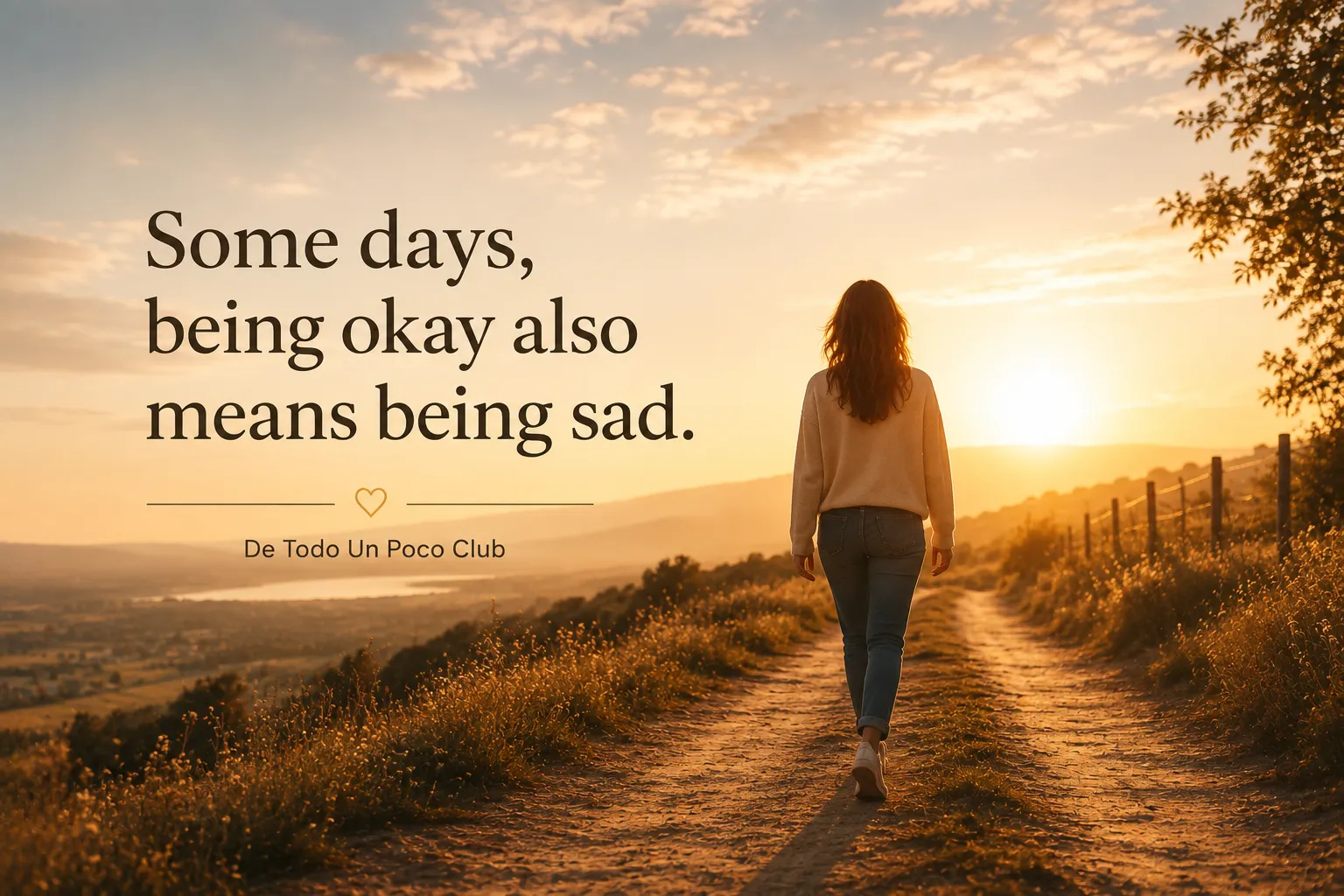
Being okay can mean getting up and continuing.
It can mean building new projects.
Falling in love with life again.
Making plans.
Traveling.
Working.
Laughing until our stomachs hurt.
Celebrating what we have.
But being okay can also mean hearing a song and becoming quiet for a few minutes.
Looking at a photograph.
Missing someone.
Crying a little.
And then continuing with our day.
Not every moment of sadness needs to be fixed.
Some moments simply need to be lived.
Because moving forward does not always mean leaving something behind.
Sometimes it means learning to walk while carrying with us what mattered, without allowing its absence to keep us from discovering everything that may still be waiting ahead.
And perhaps there is a different kind of healing in that:
not forgetting what we loved, but learning how to remember it without forgetting to live.
A Moment for Reflection
Perhaps today it is worth asking ourselves:
Is there something you spent a long time trying to “get over,” when what you really needed was to learn how to integrate it into your story?
You don’t have to answer anyone.
Sometimes it is enough to answer yourself.
Sources and Further Reading
- Hewson, H., Galbraith, N., Jones, C. & Heath, G. (2024). The impact of continuing bonds following bereavement: A systematic review. Death Studies, 48(10), 1001–1014.
- Stroebe, M. & Schut, H. (2005). To continue or relinquish bonds: A review of consequences for the bereaved. Death Studies, 29(6), 477–494.
- Root, B. L. & Exline, J. J. (2014). The role of continuing bonds in coping with grief: Overview and future directions. Death Studies, 38(1–5), 1–8.
- Stroebe, M., Schut, H. & Boerner, K. (2010). Continuing bonds in adaptation to bereavement: Toward theoretical integration. Clinical Psychology Review, 30(2), 259–268.
- American Psychiatric Association. Prolonged Grief Disorder. DSM-5-TR / Psychiatry.org.